STORY OF THE COPPER SCROLL

THE DISCOVERY OF THE COPPER SCROLL
I can tell you why, I can tell you how, and I can almost tell you who but, I cannot tell you the deep sense of desperation the first of four writers felt as he prepared for his life’s most important task. His world and way of life were gone and there was no time to reflect.
View More
ABOUT THE COPPER SCROLL
I can tell you why, I can tell you how, and I can almost tell you who but, I cannot tell you the deep sense of desperation the first of four writers felt as he prepared for his life’s most important task. His world and way of life were gone and there was no time to reflect. Every movement and strike of the tools by the priests nearby potentially exposed him and his team to danger and worse, it could reveal the location of hidden Temple treasures.
Only a few words into the sentence and his fingers ached from the iron stylus used to form the letters. There was so much more to record onto the metal document and even worse, it had to be done “backwards and in reverse.” Choosing each word carefully he wrote phrases to a person he would never meet, explaining his thoughts across centuries and he had no way to correct mistakes. Allowing his mind to drift, he searched out words for someone in the distant future to understand, but not so simple the items entrusted to him could easily be found.
His hope was in a future Israel. Would those yet unborn Israelites make the same selfish mistakes making their monumental efforts of no affect? Would the holy items again wind up in the hands of a self-absorbed people not interested or caring enough to restore the most enduring system of worship on earth?
Odds are high that the scroll will lead us to those treasures, the largest archeological discovery in recorded history. If the book of II Maccabees is accurate, and the artifacts remain in place, a magnificent archeological discovery is on the horizon filled with wonderful possibilities.
Imagine the intellectual benefits. Historians could grasp a benchmark in time for the most significant moments in moral development for two of the major religions of the world. With that in mind, consider the following and begin to formulate your own opinion.
DISCOVERY OF THE SCROLL
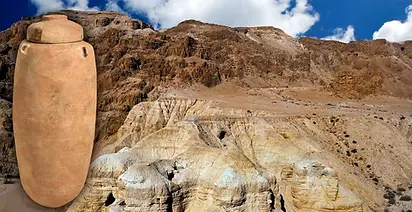
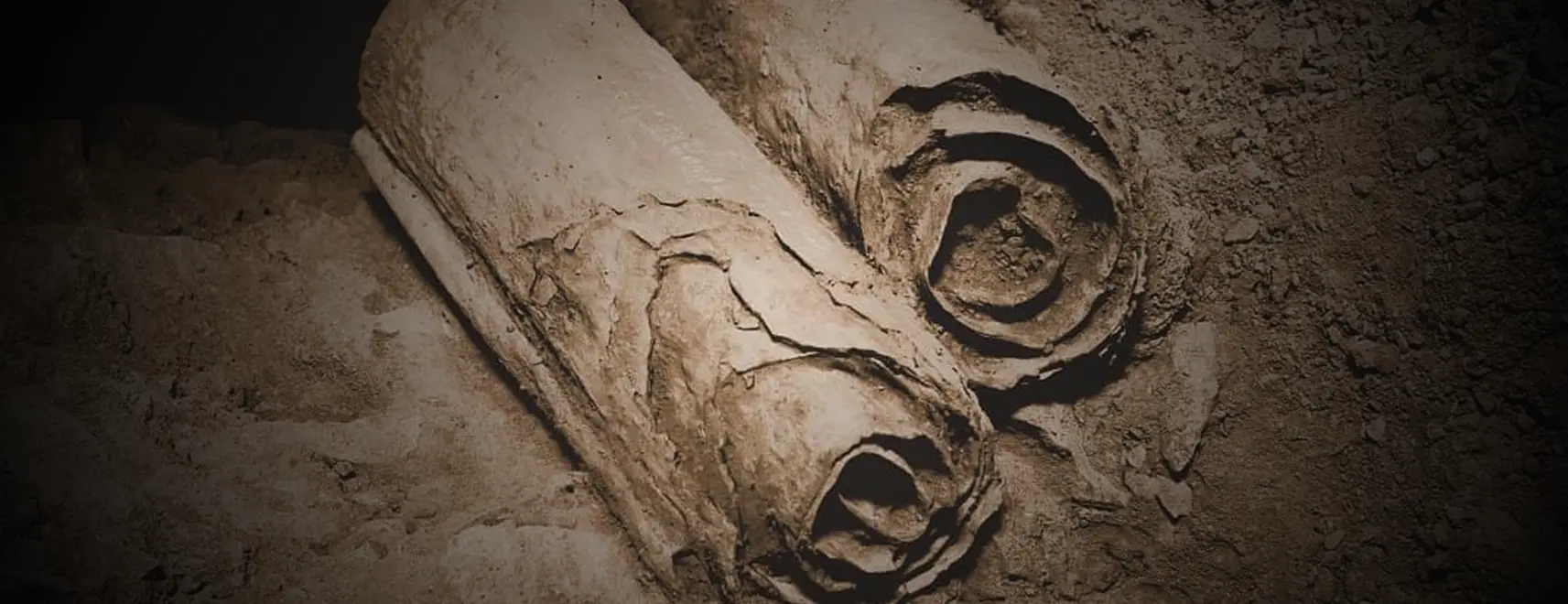
For nearly 2,400 years the scroll laid in a cave near Khirbet Qumran high above the shores of the Dead Sea until 1952. The two deteriorating rolls lay side by side on a stone outcropping in the cave hidden, according to records, by a desparate team of holy men seeking to preserve their faith. One, a single sheet of hammered copper, the other larger roll contained two similar sheets riveted together end to end. Their barely visible text pressed into the thin copper teased those that could read it unmercifully. The full measure of the secrets, however, would have to wait.
Scholarly disagreements of how to open the thing bounced back and forth for five years. If the document was ever to be opened, something had to be done. Finally, experts formulated a workable plan to open the scroll, and the delicate task fell to Professor H. Wright Baker of Manchester University. Now, fragile as glass, the scroll would be cut into sections using a tiny precision circular saw. With great care, the process began.
In an area away from public view the spinning blade screamed softly as it touched the metal. Those in attendance held their breath. Were they doing the right thing, was there another less damaging way to reveal the contents? One by one the professor gently peeled 23 half-cylinder strips from the mass of hardened clay filling its voids exposing the Hebrew words not seen in centuries. The men observing the process were thankful that this scroll was the result of a planned expedition and not the work of wreckless scavengers searching the caves for black market loot like so many others. “Thank God this scroll was discovered and protected by archaeologists,” they commented as the work dragged on. Even before the scroll was fully open the strange document exceeded their expectations. Line after line the emerging text whispered its secrets of gold, silver and gems. Scholars new the thing directed its holder to enormous treasures but, with the full text now visible, the treasures exceeded even the most liberal expectations!
ANCIENT HISTORY OF THE TREASURES
The treasures listed on the scroll probably span the history of Israel from the Exodus to the Babylonian captivity. The talents of precious metals and gems may very well be the excess materials called for by Moses and Aaron to build the Tabernacle. Then there are the supplies stored away by King David for the 1st Temple. Yet on the scroll it speaks of tithes and offerings of silver. Those could easily be from the Temple built by King Solomon and stored away for repairs and upkeep on the House of God stored in the remote treasury at Qumran. The treasury described in the document is, in my humble opinion, the long sought after treasury of Hakkoz known for centuries to be in the area of Qumran. It is unclear to me when the treasury was built. My best guess is at the time of Samuel the prophet for several reasons to lengthy to go into now. Regardless, one has to be blind not to recognize the description on the scroll matches the massive building with the sloping walls at Qumran perfectly.
ARE THE TREASURES STILL IN PLACE?
It is not clear if any of the valuables have been removed from the locations listed on the scroll but there is no indication that the hoards of precious metals have been disturbed. It would be hard to imagine that some unscrupulous person has taken the ancient artifacts and never told a soul. It is possible, however. The only way to find out if the treasures still exist is to allow testing at the ruins. We have the equipment stored in Israel, it is perfectly safe to use in the area of the ruins, so why is the ADCA holding us up?
2025 UPDATE: We finally got to perform some tests we’ve been waiting for. The results were breathtaking.
HOW MUCH TREASURE IS LISTED?
The amount of treasures described in the scroll varies greatly from scholar to scholar. Amounts are of no real importance other than to verifying that a specific location matches the amounts described on the scroll. Most of the locations consist of vast quantities of gold and silver. Some, however, are large amounts of gems and huge pottery vessels full of coins. More significantly, there are some locations that indicate that the sites contain vessels from the ritual services of the Temple of Solomon and artifacts from the Tabernacle of Moses.
It is impossible to determine the value of what is described in the scroll text. Even if we knew the exact weight of a talent, the history behind the objects drives the value of even the stone pots containing the coins beyond belief. If in-fact a talent weighs 75 pounds, the total value of the precious metals alone could be worth as much as three billion dollars and the talents of gems could dwarf that amount many times over. The value of the treasures of the Copper Scroll cannot not be measured in currency, it must be measured by historic and religious importance and that…is immeasurable.
IS THE COPPER SCROLL A MYSTICAL DOCUMENT?
The wording of the document is considered by some to be very technical and even mystical work, yet it is my opinion that the scroll’s wording is straightforward and simple in its structure. The document is not the complicated mystical literary work that some would have you believe. The history behind the document and the details it provides does make the story of the Copper Scroll very significant to historians and to theologians searching for mysterious and prophetic insight. Indeed, prophetically speaking, and God forbid, the discovery of the items of the Copper Scroll could bring about a conflict of Biblical proportions. A discovery of this magnitude in the current political climate and the enormous value of the treasures, even if Bible prophecy were nothing more than fables, creates great concern.
IS THERE PROOF THE COPPER SCROLL IS VALID?
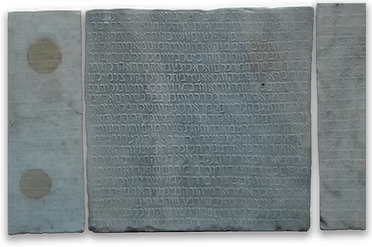
There are several documents of considerable age that refer to the Copper Scroll. All bearing witness that the text has validity. One of which is the book Emek Ha Melek penned in the 17th Century by a certain rabbi. It states specifically that at the time of Jeremiah five men hid great treasures from the Temple of Solomon and recorded their hiding places on a copper sheet. Not to mention the marble tablets found in the basement of a museum in Beirut, Lebanon in the same year that the Copper Scroll was found, 1952. Vendyl Jones must be given credit for this information since he is in-fact the person that made me aware of their exsistance. The problem is, to this date I cannot verify those particular tablets. There are tablets from the tomb of Ezekiel in Iraq housed in Jerusalem in the Yad Ben Zvi Institute. Those two tablets are supposed to be part of that collection but why were they separated and how did they wind up in Lebanon?
To read a related article of the The Jerusalem Post.

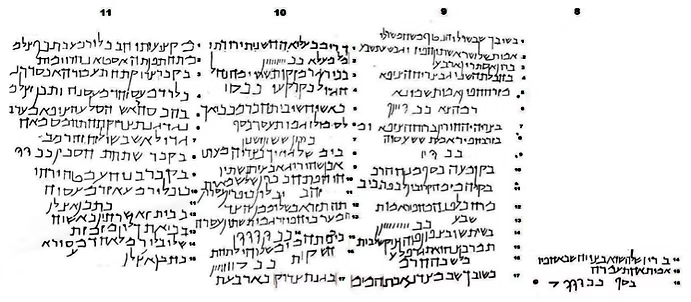
EXAMPLE OF EMEK HA MELEK EMEK HA MELEK TABLET
CLICK ON IMAGE TO ENLARGE
IS THERE HOPE OF EVER KNOWING THE ORIGIN OF THE SCROLL?
Then, there are those who suggest the treasure never actually existed, that the Copper Scroll is simply a work of fiction. Others go further to say, even if the treasure did exist, we do not know where it came from or to whom it belonged. Yet it will become obvious after the excavation. If I am allowed to assist the Israelis with an excavation, and even if I am not, the history can be determined proving, or disproving, my theory reaching an important final conclusion. As I have stated, the scroll refers to Tabernacle and 1st Temple treasures, hidden for safekeeping before the destruction of the Temple at the hands of the Babylonians.
WHY ARE THE ISRAELIS NOT EXCAVATING?
With this great treasure list, you may ask, why hasn’t everyone been out looking for it and why hasn’t a major producer made a movie about it? The truth is, some people are looking for it, but it is not easy. To begin with, until now no one understood the scroll. The words are in an older form of Hebrew that is different from today, making it more difficult to understand. As for a movie, the story needs an ending before that will ever happen. The truth is, we would have already excavated, it is the current political situation that prevents an all out operation to retrieve the artifacts, I promise you.
CONCLUSION
The Copper Scroll is nothing more than simple directions from known points, all of which I have documented. The scroll is the least of the eloquent and religious writings of the Dead Sea Scrolls but promises to be the most powerful in history. How I know this will be posted on this website in the days to come.

QUMRUSALEM - UNDENIABLE SIMILARITIES
Three sheets of extremely oxidized copper hidden centuries ago held secrets to find 57 hoards of amazing treasures described by the Hebrew words jutting from their surface. There is more to be gained from the document, far more. The text has a secret not yet realized by the scholars on matters of Qumran.
View More
QUMRUSALEM - UNDENIABLE SIMILARITIES
By Jim Barfield
Three sheets of extremely oxidized copper hidden centuries ago held secrets to find 57 hoards of amazing treasures described by the Hebrew words jutting from their surface. There is more to be gained from the document, far more. The text has a secret not yet realized by the scholars on matters of Qumran. Had the Bedouins found the scroll and sold it for scrap metal it may have brought enough money to purchase a cup of hot Turkish coffee. Another priceless aspect to the scroll, however, waits its turn in the spotlight after each trove of silver and every stack of buried gold are safely locked in vaults. Those gems of knowledge remained locked in the document’s descriptive wording just as securely as the more obvious treasures and artifacts. With each location the purpose of every room and courtyard guiding the reader to its precious dowry peels away and with it the shroud of ignorance blanketing the structure’s purpose vanishes. That unexpected knowledge detailing the spaces of Qumran will prove to be the greatest initial benefit unlocking details into a mysterious sect of men by describing their day to day use of the buildings at Qumran giving us an intimate look into their stark environment and lifestyle.
THE HARMONIOUS CALENDARS OF QUMRAN
One detail revealed by the CS that will be a great benefit to scholars and Bible students is the fact that the site of the treasures of the Copper Scroll was also the home of the Biblical prophets. Bearing that in mind, the countless scroll fragments found in the caves of Qumran take on an entirely new level of importance. For the historian/academic placing no confidence in Biblical matters, the discovery is only a significant clarification of facts. To the Bible student digging for matters pleasing to the God of Abraham, Isaac and Jacob it is of great importance.
Although there are many topics from the CS and DSS that grab the attention of those searching for answers we will begin with a simple and basic need emphasized in both, the Bible and the DSS…”timing.” The order of time, the Feasts of God and the Sabbath weighed heavy on the minds of the prophets and the Qumran sect, if in fairness, they are two separate parties. The Sabbath, although not considered a feast by some, is really the greatest of all holy days and continues to hold the highest position in the order of time throughout the Jewish world and is growing rapidly around the world for those desiring to return to our Biblical roots.
The calendars found at Qumran are intriguing. They are consistent, concise, and complete, laying out each feast on the same day of the year, same day of the month and the same day of the week, simplifying the matter of, “when are the holidays celebrated.” That is, for those attempting to reflect the image of God and happen to be trying to return to the Biblical holidays.
QUMRAN IS THE MIRROR IMAGE OF JERUSALEM
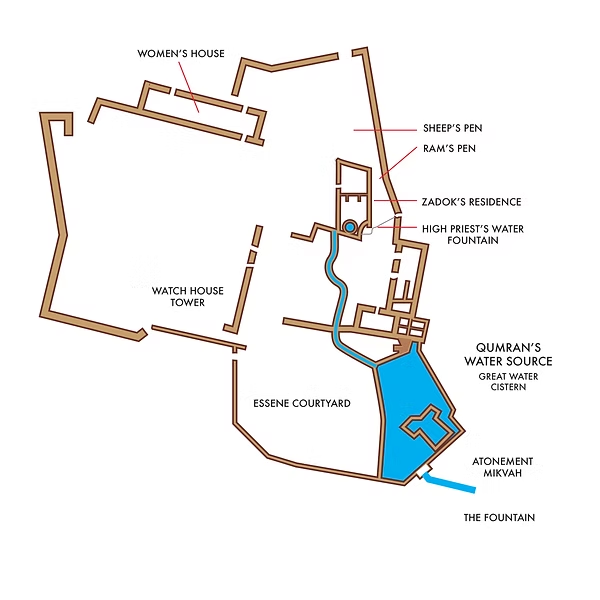
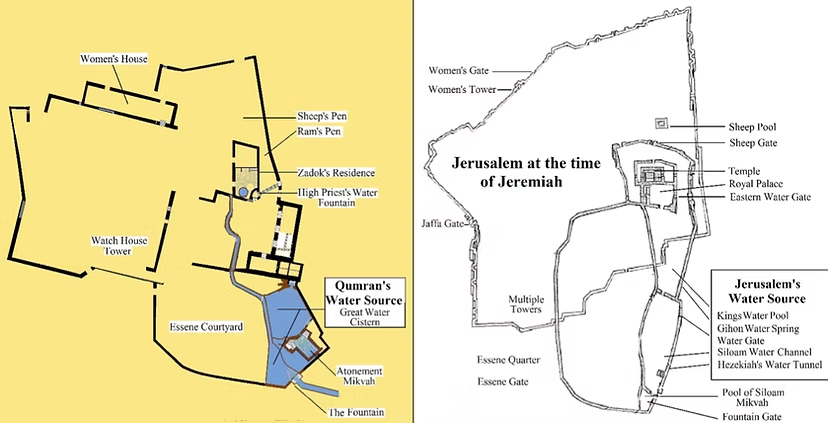
The map on the right is Jerusalem at the time of Jeremiah, on left is Qumran as described in the Copper Scroll.
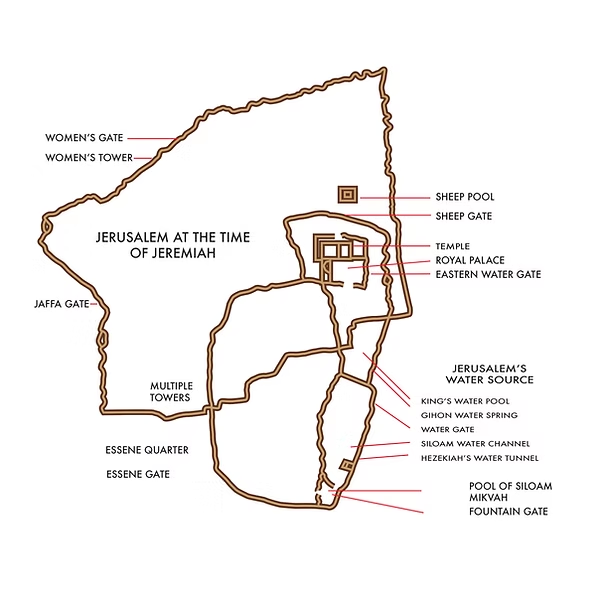
Speaking of reflections, on the right is a great example of an unexpected benefit. An interesting piece of topography caught my eye as I located an ancient map depicting Jerusalem at the time of Jeremiah; it appeared to be “Qumran upside down.” I laughed thinking someone had mistakenly inverted a map of Qumran on their website…I was wrong. In fact, after considerable examination the map was actually ancient Jerusalem and, “Qumran is an inverted image of the Holy City, Jerusalem.” But why?
After researching the matter for a couple of weeks, it appears the layout of Qumran represented the heavenly Jerusalem and its priesthood, while Jerusalem, some 15 miles northwest, represented the earthly order of things, including a completely separate Levitical priesthood. At Qumran, the priesthood preserved the golden rule, the measure for all things heavenly to which mankind was compared. They, just as the prophets of old, pounded the tables shouting the errors of halacha to the errant priests of Jerusalem. That overseeing priesthood was the Melchizedek Order, the first born of every tribe, those dedicated as Nazirites from the womb in many cases to serve the God of Abraham all the days of their vow, the salt of the earth.
HOME OF THE MELCHIZEDEK ORDER, THE PROPHETS OF ISRAEL
I once listened to a radio talk show out of Israel where the Jewish host was dumfounded when her purely Jewish guest stated that the Book of the Revelation was not originally a Christian document. It was Jewish, written by Jews for Jews and those fearing God. That being the case, the Book of the Revelation describes a totally separate priesthood from the Levites. How do I know it is separate? Only Levites can be priests, yet in the revelation all twelve tribes of Israel provide pure first-born sons to serve among its ranks; restoring the nation of priests desired by God from the beginning. The Melchizedek Order is a powerful matter with intriguing implications.
Anticipated and many more unexpected benefits of the CS are to be laid out in detail in the following months and my research will be made available for all to purchase giving details of all 57 locations of Moses’ and Solomon’s Treasures. Keeping quiet about these discoveries is no longer an option but working in concert with those in authority for the safety of the antiquities and being as careful and responsible as possible to reduce complicated issues is, but Israeli government officials “must” communicate. At a non-sensitive level, keep me informed so nothing will be said from my end damaging a fragile relationship with those countries looking for an excuse to rant. I continue to ask for non-sensitive guidance and friendly cooperation from Israel authorities “for the safety of the artifacts, Qumran and the people involved.”

THE LOCATION OF JEREMIAH'S DEED (JER 32)
Jerusalem was under siege, Babylon had Judah’s army at a breaking point and Jeremiah was chained in the house of his King. The rusty chains cut into his wrists binding him to the wall, his punishment for prophesying the truth, a tragic end to Zedekiah and his kingdom.
View More
THE LOCATION OF JEREMIAH'S DEED
By Jim Barfield
Test Question. Is Jerusalem in the land of Judah or the land of Benjamin?
Jerusalem was under siege, Babylon had Judah’s army at a breaking point and Jeremiah was chained in the house of his King. The rusty chains cut into his wrists binding him to the wall, his punishment for prophesying the truth, a tragic end to Zedekiah and his kingdom. “Behold, I will give this city into the hand of the king of Babylon, and he shall take it; And Zedekiah king of Judah shall not escape out of the hand of the Chaldeans but shall surely be delivered into the hand of the king of Babylon, and shall speak with him mouth to mouth, and his eyes shall behold his eyes. You and all of Judah will not prevail and will suffer greatly at the hands of the Babylonians.” Jer 32:3 – 4
JEREMIAH LAMENTING
The Year of Jubilee was only a couple of months away and as you may know, the Year of Jubilee is a massive celebration of “Freedom” occurring every 50 years. Ironic or sign of the times? That special year was always announced on the Day of Atonement. On the Day of Atonement, the High Priest stands in perfect safety before Elohim, the God of Abraham “face to face,” mouth-to-mouth and eye-to-eye while the rest of the world outside the walls of Jerusalem stood judgment. Because of the kingdom’s disobedience, judgment would now be upon Judah and, their puppet King would stand “face to face” before his pagan god Nebuchadnezzar. The last thing he would see was the death of his sons, moments before his eyes were burned from his skull on, of course, the Day of Atonement. Make no mistake. The timing was no coincidence and the judgment for such an evil king was just.
While in the court of that prison Jeremiah had a visitor, his cousin, sent by his uncle Shallum. He had brought paperwork for Jeremiah to purchase back the family fields in the land of Benjamin. Seventeen shekels were weighed out, documents signed, and the land was back under Jeremiah’s family trust. The prophet was acting as a redeemer as required before the special year began. Baruch, Jeremiah’s scribe, took the two copies of that deed, one open and one sealed, placed them in an earthen jar so they would “last for many days.” Just as the men of Qumran stored its documents, Jeremiah stored the deeds for the distant future. Other Jewish documents state that the deeds were buried; I wonder…could they be in the CS Cave? If those legal documents are found do you think the squatters around Israel will grab their bags and head back to the countries, they are from…mmm maybe not. Will the Copper Scroll Cave contain Jeremiah’s Deed?
JEREMIAH REDEEMS LAND
Potential Buried Opening to the Cave of the Copper Scroll
“If” the Melchizedek priesthood was functioning at Qumran, creating the dual imagery mentioned in “Unexpected Benefits of the Copper Scroll,” there must be some indication of it in the Bible and certainly some in the DSS. A copy of a DSS document referred to as the “Melchizedek Fragment” [1] is available on-line and as a pop-up note on my TLM. [2] Take a few moments, read the fragment, compare it to the Timeline of the Messiah (soon to be posted) and consider the possibilities of the prophetic match the timeline presents. Another potential link of the treasury at Qumran and the Melchizedek Order is the note in the book of Genesis where Abraham pays tithes to the reigning Melchizedek, whose name, by the way was, Shem. Abraham is providing riches to Shem, one in a long line of Melchizedeks leading up to the community and treasury at Qumran. Admittedly, the comparison is a stretch, but a noteworthy stretch.
Now is a good time to follow up on comments I made earlier about Jeremiah repurchasing Benjamite land and how it affected his priestly duties. If Jeremiah was a “Levitical” priest, why repurchase Benjamite land? In-fact, if Jeremiah was a priest, the scripture should read, “buying back land of the Levites in the allotted land of Benjamin.” Either way, the sale of Levite land was an illegal act according to Torah. In chapter 32 Jeremiah acts as “kinsmen redeemer” as required by the Torah in preparation for the Year of Jubilee. Torah forbids the selling of Levitical “fields.” [3] They can sell a home built in a Levitical city but not the land. Leviticus 25:33-35 makes that very clear and closes with, “But the fields [4] of the open land about their cities may not be sold; for that is their (the Levites) perpetual possession.” Jeremiah is redeeming “a field,” not a house. That being the case, Jeremiah’s family committed an intentional breach of the Torah, if they were Levites, something the righteous man’s family would “probably” never do.
Every verse referring to the purchase in Jeremiah 32 refers to “fields” [5] being redeemed. In the closing verses of chapter 32, God makes a promise of restoration, building on the point of prosperity and the buying and selling of “Benjamite land,” which reinforces my point – “Levites” cannot sell their fields. So again, if Jeremiah is a priest, and priests are all Levites, how is it that Jeremiah could be a Benjamite area “Levite” and have no restriction on buying or selling family land?
Jeremiah’s father was a priest [6] so he had to be Levite correct? Not necessarily. According to the Bible, there are two priesthoods: [7] the Levitical Priesthood and the obscure “Order of Melchizedek.” Each apparently had its own High Priest: one in Jerusalem and the other, at the mirror image of Jerusalem called Qumran “the Community of the Eternal Covenant.” [8] Since there is “no” restriction for the Melchizedek Order Priests, who were first-born and self-dedicated priests from every tribe, the land could be sold and redeemed at the designated time. To reiterate that Qumran had a separate priesthood, the CS even identifies one location by referring to the High Priest at Qumran calling the structure “the fountain of the High Priest.” [9] That fountain is constructed in the same room identified by the CS as the room for the “Teacher of Righteousness.” The room is called the “residence of the Righteous” named in location L46.
It is difficult for me not to envision the men of the Qumran community as anything other than the mirror image of the heavenly Jerusalem not just the city of Jerusalem. Repeatedly, the CS names buildings and places matching the structures at Qumran today, all damaged, but easy to recognize. One ostentatious building stands strong, withstanding the ages and the attacks of at least two pagan armies with its lower portion almost intact. That building is, or was, the treasury, the building at Qumran with the sloping walls.
I cannot help but wonder if the deed referred to in Jeremiah chapter 32 is buried in the same cave described in L57 of the Copper Scroll. If it is, will the deed refer to a piece of land far more significant than is apparent? How awesome would it be if the deed were connected to the most important piece in Benjamite territory, in fact, the most important property on Earth…the Temple Mount.
Answer to the Test Question…The Temple Mount is in the land of Benjamin!
[1] 11Q13 [2] Line 3583, Column AB [3] Strong’s number H7704 [4] Strong’s number H7704 [5] Strong’s number H7704 [6] Jeremiah 1:1 [7] Gen 14:18, Psalms 110:4, Hebrews 7:11 [8] Community Rule Col 5, line 5 [9] Copper Scroll L28
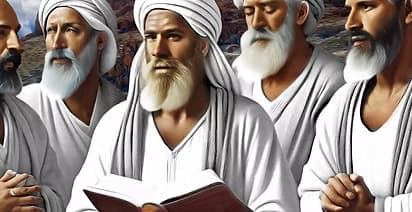
THE PROPHETS THAT WROTE THE COPPER SCROLL
Jerusalem was under siege, Babylon had Judah’s army at a breaking point and Jeremiah was chained in the house of his King. The rusty chains cut into his wrists binding him to the wall, his punishment for prophesying the truth, a tragic end to Zedekiah and his kingdom.
View More
THE PROPHETS THAT WROTE THE COPPER SCROLL
By Jim Barfield
Below are verses from the Book of Haggai, one of five men said to have written the Copper Scroll (CS). Two of those men were prophets from the Bible, “Haggai and Zechariah.” That information comes from two sources; one is a 17th century book called “Emeq Ha Melek (Valley of the King).” The second source has nearly identical wording and dates the Copper Scroll to the time of Jeremiah, Haggai, Zechariah, Ezekiel and the war with Babylon.
The opening lines of the second document, two Marble Tablets from Ezekiel’s tomb, also names the same “five writers.” Imagine…if those two documents are correct, you are looking at the handwriting of Haggai and Zechariah when you check out the facsimile of the Copper Scroll below. Those five men, assisted by 100 priests, buried amazing things, portions of which you will find listed in excerpts from Emeq Ha Melek in this week’s same article.
JEREMIAH AND THE FIVE WRITERS OF THE COPPER SCROLL
Haggai 2:6 For thus saith the LORD of hosts; Yet once, it is a little while, and I will shake the heavens, and the earth, and the sea, and the dry land;
7 And I will shake all nations, and the desire of all nations shall come: and I will fill this house with glory, saith the LORD of hosts.
8 The silver is mine, and the gold is mine, saith the LORD of hosts.
9 The glory of this latter house (Temple) shall be greater than of the former, saith the LORD of hosts: and in this place will I give peace, saith the LORD of hosts.
Below are the opening lines and the first two Mishnayot or “Records” from Emeq Ha Melek.
Opening lines of Emeq Ha Melek… (Literally: Valley of the King)
By Rabbi Naftali Ben Ya’acov Elchanon in the year 1648
These Mishnayot “Records” were written by five righteous men. They are: Shimur the Levite, Hizkiyah, Zidkiyah, Chaggai the Prophet and Zechariah, son of Ido the Prophet. They concealed the vessels of the Temple and the wealth of the treasures that were in Jerusalem which will not be discovered until the day of the coming of Mashiach, son of David, speedily in our times, Amen, and so it will be.
Mishnah 1
These are the vessels dedicated and concealed when the Temple was destroyed: The Tabernacle and the Curtain, the Holy Menorah, the Ark of Testimony, the golden forehead Nameplate, the golden crown of Aharon the Cohen, the Breastplate of Judgment, the silver Trumpets, the Cherubim, and the Altar of burnt offerings, the Curtain of the Communion Tent, the forks and the bread molds, the Table [of the Showbread], the Curtain of the Gate, the Copper Altar, the sacred garments of Aharon which were worn by the Cohen Ha Gadol (High Priest) on the Day of Atonement, Pa’amonim (bells) and Rimonim (pomegranates) on the hem of the robe [of the Cohen Ha Gadol], the holy vessels that Moses made on Mount Sinai by the command of the Holy One, the Staff, and the Jar of the Manna.
Mishnah 2
These are the holy vessels and the vessels of the Temple that were in Jerusalem and in every place. They were inscribed by Shimur HaLevi and his companions, on a “Luach Nehoshet” (Copper Plate), with all the Vessels of the Holy of Holies that Shlomo (Solomon) son of David made. And together with Shimur were Hizkiyahu, Zidkiyah, Haggai the Prophet, and Zechariah, son of Berachiah, son of Ido the Prophet.
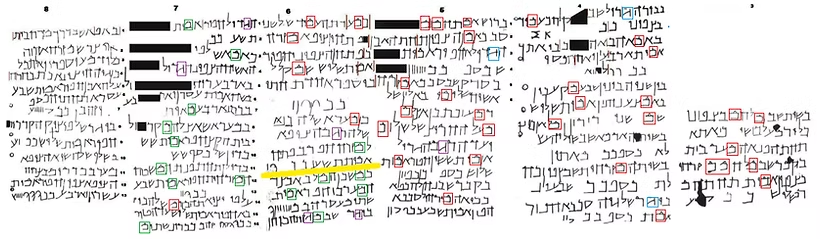
From the time that I determined the number of burial locations for each writer on the CS it seemed odd that Writer 2 had so many, and Writer 5 had so few. I figured out that Writer 2 was actually Writers 2 and 3. It wasn’t until after I examined the Hebrew letters very closely that I determined a breaking point between the two. That breaking point explains why Writer 2 appeared to have so many locations. Writer 5 was probably Shimur because his locations made a perfectly straight line leading up to the buried cave, which will be discussed in a future article for “Nuggets from the Copper Scroll.”
Writers 2 & 3 were difficult to distinguish. The only way to determine where the separation was (if I am correct) was to watch where a noticeable change took place with the Hebrew letter for “M” (enclosed in green and red squares). Why did they use five writers and not one well-trained and skilled calligraphist [1] to record the locations? Instead, according to Emeq Ha Melek, Shimur used four men, or boys, or a combination of both, with the calligraphy skills of a kindergartener.
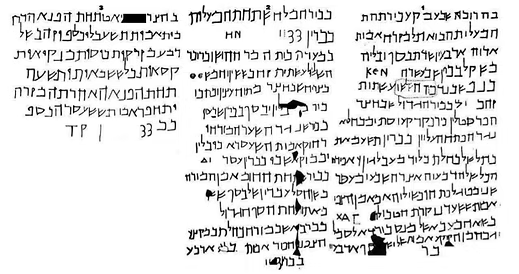
If Qumran was the site of the battle Rabbi Elchanan wrote about in Emeq Ha Melek, the slaughter killed over fifty percent of the priests responsible for guarding the Treasury. According to the same document, the Babylonian attack failed but at a great cost to the men at Qumran. The priests, however, held the ground. If indeed ancient Qumran contained a large portion of the CS items, the siege strongly motivated the men of the ancient stronghold to hide the valuables and the treasures of the Tabernacle. By doing so they kept the last remaining, desperately needed implements out of the hands of the pagans. But it also required meticulous planning to keep the treasures safe at each phase of the process applying counter measures to prevent loss from accidental discovery and from moral failure of the men doing the hiding. That many men hiding that much treasure made for a compromising situation. Divide and separate the teams, however, and reduce the amount of loss should one member of a team decide to sneak back for a talent or two of the treasures.
The Greek Letters of the Copper Scroll
Several mysterious Greek letters appear randomly on the document for no apparent reason, posing an obstacle to complete understanding of the CS. Those Greek letters are Indiana Jones kind of interesting and may be transmitting a prophetic message 2400 years after the fact, that is, if my analysis is correct. But to be honest, a clear picture of the meaning of the Greek may elude us until recovery of the items at the last location on the CS, the buried cave. If the additional document recorded to be there exists, as the CS claims, a comparison of the two should render an answer. Posted are the Greek letters found on the scroll in descending order of appearance with the English equivalent to the right.
[1] I first learned of the four writers from my friend Vendyl Jones. Vendyl Jone’s website was at the time a source of information on this subject, however Vendyl’s analysis of the locations featured on the CS was, and is, totally and completely
different than my research listing the locations of the Copper Scroll.